
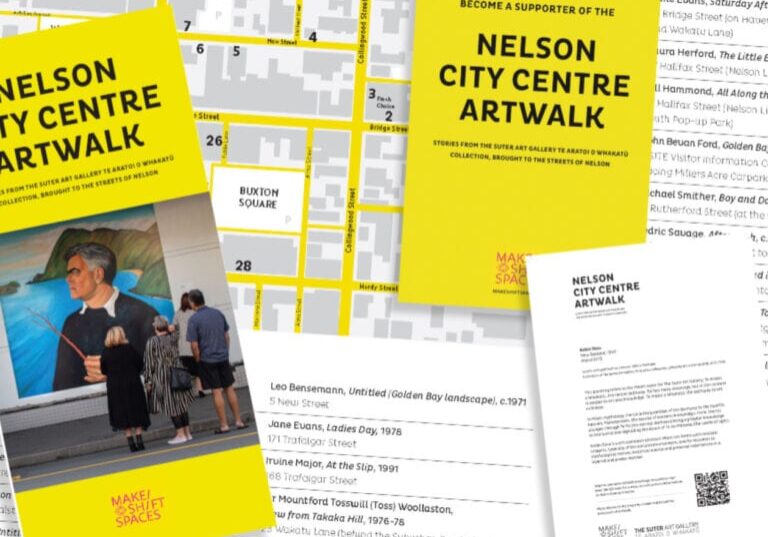
Lessons from the Nelson City Centre ArtWalk by Make/Shift Spaces (MSS) and the Suter Art Gallery
What is the ArtWalk?
The Nelson City Centre ArtWalk is a walking trail of more than 20 supersized reproductions of artworks, mounted on walls around the central city. Each work is drawn from The Suter’s collection and has a regional story to tell. A walker can complete the route in about an hour.
The idea came from Anne Rush, originator of the project and the driving force behind Make/Shift Spaces, the agency that runs programmes to enliven Nelson’s city centre. It arose during the 2020 COVID lockdowns, when cultural facilities were closed and walking was all residents could do. It has been a success well beyond expectations.
The core idea
- Regional storytelling. Every artwork has a local connection. This defines the project as part of Nelson and is essential to how it is communicated.
- Accessible art. It brings art to people who wouldn’t usually visit a gallery, including locals who might happen upon the works during their daily business.
- Civic pride. The works become landmarks and talking points, and give the city an identity tied to our place and its cultural history.
Step by step
Many of these stages can run in parallel.
1. Identify sites
Collate a list of bare walls of varying sizes, free of advertising, signage and other obstructions. They must have good sightlines for pedestrians, and most importantly be safe for pedestrians to stop and look (eg – we identified a perfect wall along a sideroad, but because there was no immediately-adjacent footpath, we couldn’t use it). Most of the sites around Nelson are private property, and because we are a relatively small regional city, most of the property owners are local. Ideally, find more sites than you anticipate you will need, need as a backup.
2. Choose the artworks
Select works with regional significance and storytelling potential: artists connected to the region, local scenery, regional industries, and local personalities etc. The really fun part was matching the artworks to site, keeping a strong curatorial ethos that showed each artwork to its best advantage.
3. Create a prospectus and raise funds
Create a document with mock ups of the selected artworks on the propective walls. This is useful for both the property owners, and as a pitch document for sponsorship. Funding sources included sponsorship, in-kind support and grants.
4. Secure wall permissions
Engage with the property owners (and tenants or occupiers) and seek their permission. Formal agreements signed by all parties are needed. In Nelson, a lawyer drafted a Wall Licence Agreement. Response was overwhelmingly positive: of 26 sites, only one owner declined.
5. Secure artist and copyright permissions
The director of the Suter Art Gallery wrote personally to each artist or copyright holder, setting out the ArtWalk concept and reproduction standards. The personal approach led some estates to waive reproduction fees, brought extra information in replies, and created enthusiastic advocates.
6. Prepare high-quality images
Use the highest quality and resolution possible, as works are reproduced far larger than the originals. Reproduce each work as the full uncropped image.
7. Produce and install the panels
Panels are signwriter’s vinyl wrapped over aluminium composite panel, made in proportion to the originals. Some works comprise multiple panels. Producing a batch at once lets signwriters work economically, for example using offcuts for the A3 label boards. Panels have far exceeded expected lifespans, with fading only on the most north-westerly exposed sites, and vandalism has been almost non-existent. To date, there have been four reprints with an added uv coating to sustain the artworks’ colours.
8. Write the labels
MSS wrote the labels, deliberately avoiding “art gallery speak”. Labels are formatted like gallery labels but the copy is brief and readable. Each label carries a QR code linking to the online map and to more information on the artwork.
9. Build the online layer
The website elaborates on each artwork with history, context and further links. The online site also has a map, so that people can self-guide around the ArtWalk. The QR codes on the labels have consistently made the ArtWalk the main driver of traffic to the MSS website.
10. Promote and build support
Win buy-in from the Council, tourism and development agencies, and community groups such as Rotary and other service clubs, heritage and arts organisations. Commission professional photography of the installations and launch event, as well as candid imagery of a mix of people looking at artworks. A printed brochure with a map remains extremely popular, especially at the Suter Art Gallery (the official “start” of the ArtWalk) and for accommodation providers.
11. Look after it long term
Stay the contact point for building owners, especially if a building is being rebuilt or changed. Maintain a fund so panels can be replaced, moved or reinstalled elsewhere.
Benefits
- Encourages people to explore on foot, which is good for cafes and retailers along the route.
- Works for both locals and visitors.
- Links to guided tours, the annual heritage festival, fundraisers and education programmes.
- Drives visits to the gallery.
- Brightens the town.
- Can be replicated: The Suter, with MSS’s permission, used the approach for town centres in the Tasman District, funded entirely by grants, donations and sponsorship. This also raised the gallery’s profile with Tasman District Council.
Things to reflect on
- Māori representation. Māori artists are currently underrepresented in the ArtWalk, mainly because the Suter’s collection is weighted towards European history.
- Contemporary artists. Only one of the original 26 artworks, only three were by living artists. Consider whether to include more contemporary work.
Resources available
- Wall Licence Agreement
- Fundraising Prospectus
- Paper brochure with map